The question "best wine region in Washington State" arrives at this desk in the wrong shape. We draw European regions — Bordeaux between the Garonne and the Dordogne, Burgundy on the east-facing slope of the Côte d'Or, Champagne on the chalk north of the Marne, Alentejo on the warm plains east of Évora — and we have learned, drawing them, that "best" is never a taste vote. It is a geography argument, and the argument runs on ten specific words. You do not need to be a sommelier to use those words. You do need them before you rank anything, in Washington or anywhere else.
Main River
A main river is the single watercourse that organises a wine region on the map — the axis every other geographic fact bends around. It matters because rivers do three jobs at once: they cut the valleys the vines climb out of, they moderate temperature at night through mass of moving water, and they historically carried barrels to the port that gave the region its name. Bordeaux is not a name for a taste, it is a name for a place on the Garonne where the estuary meets the town, and everything commercial about the region — the négociants, the château system, the export contracts — sits downstream of that fact. Burgundy is drawn around the Saône, the slow river running south past Beaune. Champagne is the country that opens above the Marne. Alentejo, in southern Portugal, is organised around the Guadiana. Ask which river a region belongs to first. If nobody can name one, the "region" is a marketing polygon, not a geography.
Aspect
Aspect is the compass direction a vineyard slope faces — south, east, southwest, north — and it decides how many hours of direct sun the vines receive and at what angle those hours land. The word does most of the quiet work behind terroir talk. A south-facing slope in the northern hemisphere is a warm slope; an east-facing slope catches morning sun and cools in the afternoon; a north-facing slope, at latitude, may not ripen at all. Burgundy's Côte d'Or is the textbook case: the golden slope faces east, taking the morning sun off the plain and losing the harsh late light behind the ridge. The great walled vineyards between Dijon and Nuits-Saint-Georges — and further south past Beaune — are lined up along that single east-facing wall. Aspect is why one side of a Burgundian hill produces the wines the world writes about and the other side produces something else entirely. When someone claims a region is "best", ask which way its slopes face and why that matters at that latitude.
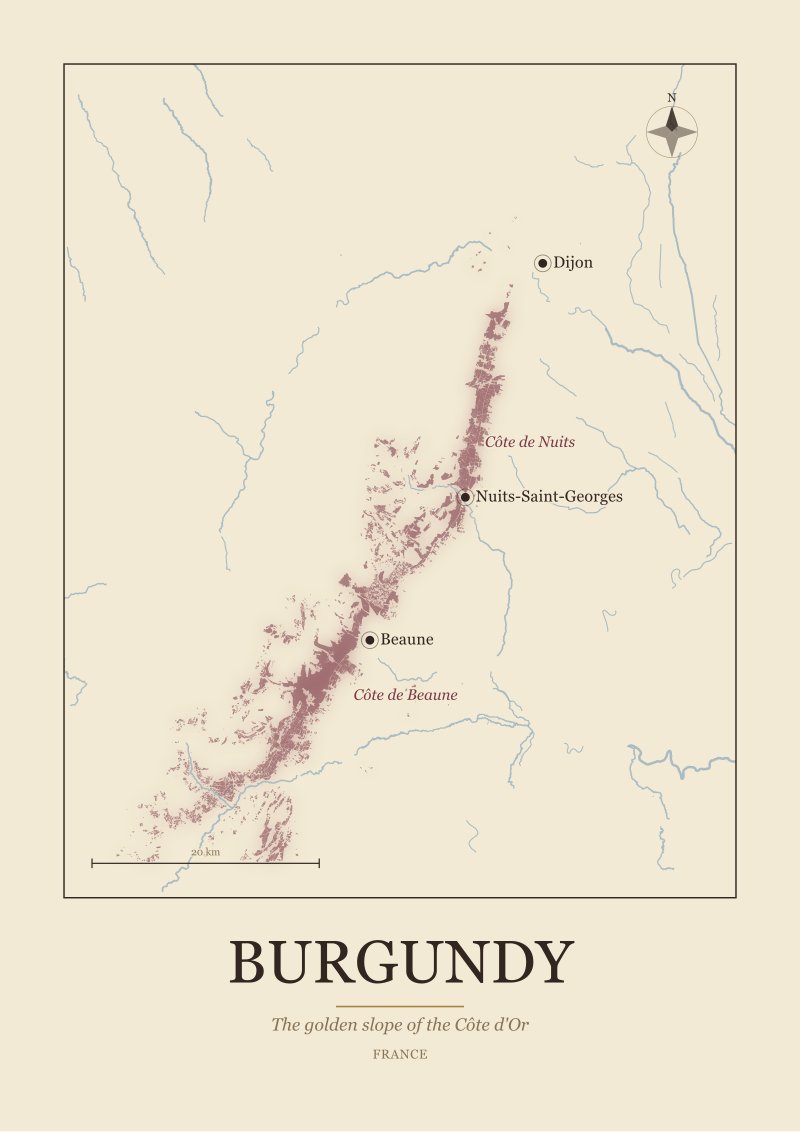 Burgundy
The print from this article · from €29.95
View the print →
Burgundy
The print from this article · from €29.95
View the print →
Slope Gradient
Slope gradient is the steepness of the vineyard, measured in percent or degrees. It sounds like a farming detail. It is not. Gradient decides how much soil erodes each winter, how much sun the row catches at a given aspect, whether you can drive a tractor down the row or must work by hand, and — quietly — whether the water drains fast enough to stress the vine into concentration. Flat land grows generous wine; steep land grows structured wine, at higher cost. The C̥ôte d'Or's east-facing wall is not merely oriented east, it is tilted at a gradient sharp enough that the vineyards read as a slope from the plain below, and each named vineyard sits at a specific band of that tilt. In Champagne, the chalk hills north of the Marne are not dramatic mountains — they are rolling slopes gentle enough to plant densely, steep enough to drain the shallow soils. Gradient without aspect is a hill. Aspect without gradient is a picture on a map. You need both to argue "best".
Anchor Town
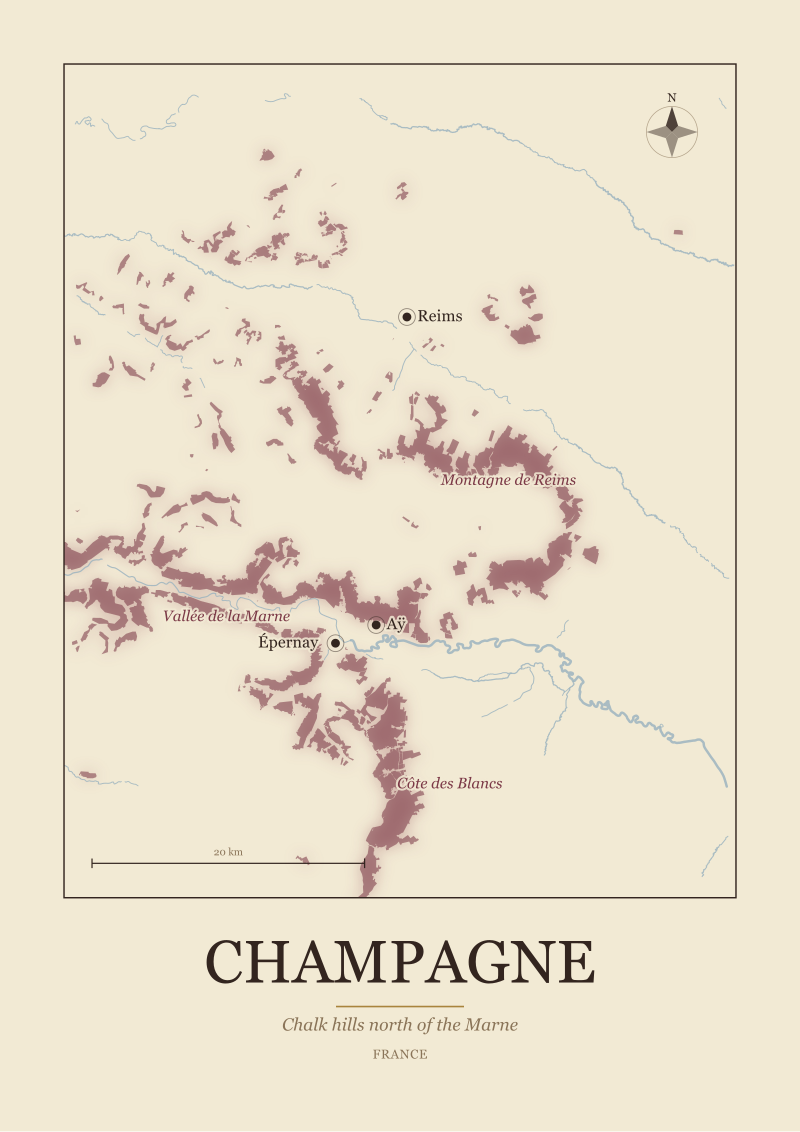
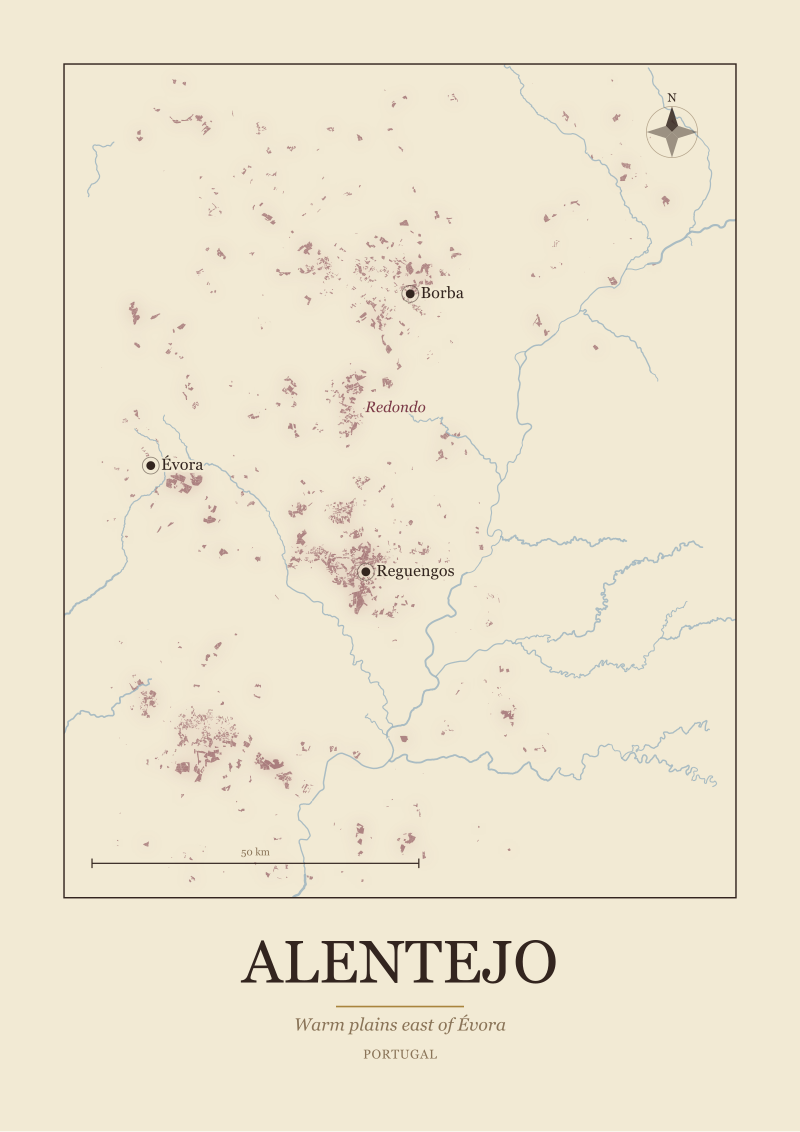
An anchor town is the town whose name a region uses when it introduces itself: the market, the négociant hub, the cathedral square, the train station the barrels left from. Every serious wine region has one, sometimes two, and their locations are the region's centre of gravity. Bordeaux the region is anchored by Bordeaux the city on the Garonne, with Saint-Émilion and Pauillac as secondary anchors that name their own sub-territories. Burgundy runs between Dijon in the north, Beaune in the middle, and Nuits-Saint-Georges between them, each town anchoring a stretch of the slope. Champagne is organised by Reims to the north, Épernay to the south, and Aÿ on the Marne itself. Alentejo works through Évora, Reguengos, and Borba. Anchor towns are the checkpoints on any honest wine map. If you cannot list two or three named towns of a "region", you are looking at an area, not a place — and no area has ever earned "best" of anything.
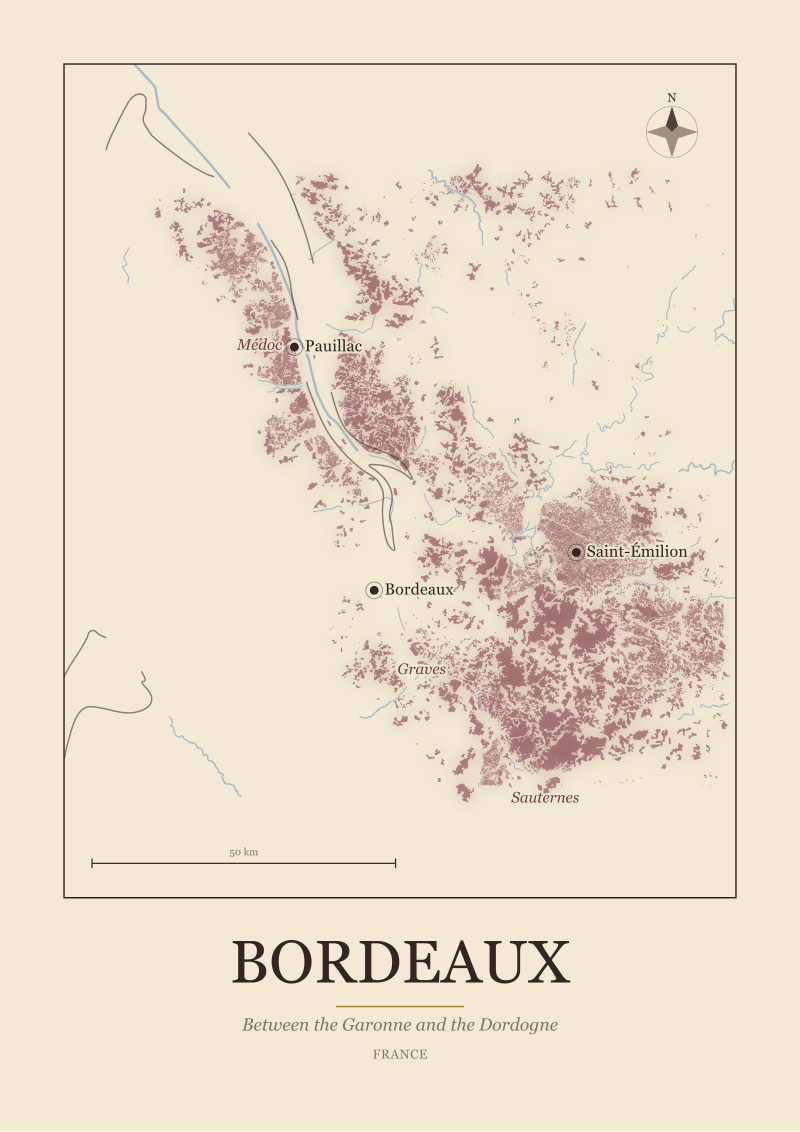 Bordeaux
The print from this article · from €29.95
View the print →
Bordeaux
The print from this article · from €29.95
View the print →
Subzone
A subzone is a named piece of a larger region — a place inside the place, drawn tightly enough that the geography inside its border is meaningfully different from the geography outside. Subzones exist because regions are not homogeneous. Bordeaux contains the Médoc on the left bank, Saint-Émilion on the right, Graves to the south of the city, and Sauternes further south still — four subzones with four distinct geographic characters, all trading under the same regional flag. Burgundy divides its golden slope into the Côte de Nuits in the north and the Côte de Beaune to the south, two halves of one wall with different exposures at different points. Champagne organises itself as the Montagne de Reims, the Vallée de la Marne, and the Côte des Blancs — a mountain, a valley, and a slope, each named by what it geographically is. Alentejo names Borba, Redondo and Reguengos among its subzones on the warm plains east of Évora. When you argue "best region", you are almost always arguing "best subzone" without realising it. Name the subzone or the argument is empty.
Appellation Border
An appellation border is the legal line drawn around a subzone (or a region) inside which specific rules apply: which grapes may be planted, sometimes which practices may be used, and which name the finished wine is allowed to print on its label. The border is not a geography fact; it is a geography fact turned into a rule by a national or European authority. That distinction matters. Two vineyards two hundred metres apart, on the same slope with the same aspect and the same bedrock, can sit inside and outside the same appellation and command wildly different prices — because the line, once drawn, becomes the market. In Bordeaux, the boundary between Saint-Émilion and its neighbours is a legal instrument, not a physical wall. In Burgundy, the Côte de Nuits and Côte de Beaune borders divide the same continuous slope. Appellation borders are how administrative history overwrites geography — and, sometimes, how geography quietly overwrites the administration.
Bedrock
Bedrock is the rock under the vine, beneath whatever topsoil has weathered on top. It matters for two reasons only, and both are geological: it decides how the vineyard drains, and it decides what minerals the vine's roots reach when they push down through the softer material above. Champagne's answer is chalk — the pale, porous white rock that holds and releases moisture, gives the region its cellars carved into the hills at Reims and Épernay, and defines the character of the chalk hills north of the Marne. Bordeaux's left bank is defined by gravel deposited by the Garonne over millennia; the right bank runs on clay and limestone. Burgundy's east-facing slope is a layered limestone geology exposed by the tilt of the Côte d'Or. Alentejo's plains sit on a different, older bedrock again. When someone says a region is "distinctive", they usually mean the bedrock is doing something specific. Ask what the rock is. If the answer is vague, distinctiveness is vague.
Latitude
Latitude is the north–south position of the region, measured in degrees, and it controls two things that decide whether wine is possible at all: how much sun the vines receive across the year, and how long the growing season lasts before autumn shuts it down. Wine's classic European band runs roughly from Champagne in the north to Alentejo in the south — a belt where the sun is enough but not too much. Champagne sits far enough north that grapes barely ripen, which is precisely why the region produces the style it does: high acidity, low base-wine alcohol, structural bones for a second fermentation. Alentejo sits far enough south that the sun is generous and the vine's problem is heat, not cold. Bordeaux and Burgundy sit between. Latitude is the ceiling and floor of every other conversation about "best". A region cannot be argued upward through effort; it can only be argued within what its latitude permits.
Rain Shadow
A rain shadow is the dry zone that forms on the leeward side of a mountain range, where prevailing wet weather has already dropped its moisture climbing the windward slope. It is the geography term that explains why some wine regions exist at all in places that look, on a broad climate map, too dry to grow anything. Rain shadow is why irrigation politics matter, why altitude and river access become defining, and why a region's "character" can be, in effect, the character of the mountain range fifty kilometres upwind of it. Our grounding here is European — the four regions we draw sit in temperate Atlantic and continental climates where rain shadow is a secondary factor, not the primary one. But the term travels. Any serious "best region" argument about a place downwind of a major range — the interior west of North America being the obvious case — has to begin with the shadow the range casts, because that shadow is the region's real weather.
Growing Season
The growing season is the count of days between the last spring frost and the first autumn frost — the window inside which the vine can actually work. It is the summary variable that latitude, aspect, gradient, and local weather all feed into. Champagne's growing season is short and marginal; the region's whole style is a response to that shortness. Alentejo's is long and warm; its whole style is a response to that length. Burgundy's east-facing wall stretches its usable season by catching morning sun that a west-facing wall of the same latitude would miss until noon. Bordeaux's estuary moderates both ends of the season, softening frost risk in spring and dragging warmth into October. When a region's growing season is written down honestly — start date, end date, average length, frost risk at either edge — most of the argument about which region is "best" for which style resolves itself. The window is the region. Everything else is what the region does with the window it was given.
You now have ten words that are not decorative. They are the argument. Apply them to Washington State, to Chile, to South Australia, or to a hill you are looking at through a train window in France, and the phrase "best wine region" starts producing answers instead of opinions. When those answers point to a region you want to hang on a wall, our shop draws the same geography — river, slope, subzone, appellation border — that this glossary describes.
FAQ
Why does this article about Washington State keep talking about European regions?
Because this desk draws European wine regions from real geography and reasons from what we can verify. The ten terms — river, aspect, slope gradient, anchor town, subzone, appellation border, bedrock, latitude, rain shadow, growing season — are portable. They decide "best" in the Columbia Valley the same way they decide it in the Médoc. We teach the vocabulary on ground we know so you can carry it to ground we don't.
Is "best wine region" even a meaningful question?
Only once you specify what "best" means: best for a style, at a price, in a season, at a latitude. A region cannot be best in the abstract. The Champagne answer to "best" is different from the Alentejo answer because the latitude, the growing season and the bedrock are different. Naming which of the ten terms you're optimising for is the whole game. Without that, "best" is a taste vote in disguise.
What is the difference between a region and an appellation?
A region is a geography — a river, a slope, a set of anchor towns, a shared bedrock. An appellation is a legal border drawn around some part of that geography by a national or European authority, defining which grapes may be grown and which name may appear on the label. Bordeaux the region contains many appellations; Saint-Émilion is one of them. The region is the terrain; the appellation is the rulebook on top of it.
Why does aspect matter so much in Burgundy specifically?
Because Burgundy's most famous vineyards run along a single east-facing wall — the Côte d'Or — where the slope takes morning sun and loses afternoon heat behind the ridge. At Burgundy's latitude, an east-facing tilt is the difference between grapes that ripen with tension and grapes that struggle. Slopes facing other directions on the same hill produce measurably different wines. Aspect is doing more work there than in warmer regions where sunlight is not the limiting factor.
Is bedrock really that important, or is it marketing language?
Bedrock is real and measurable. Champagne's chalk holds water and drains excess, and the region's cellars are literally carved into it beneath Reims and Épernay. Bordeaux's left-bank gravel drains fast; the right-bank clay holds moisture. These are physical facts with cellar-visible consequences. The marketing distortion is when "minerality" is used as a flavour claim untethered from a specific rock. Ask which rock. If nobody can name it, the claim is decorative.
Do you recommend specific Washington producers or bottles?
No. This desk is a wine geography desk, not a shop or a tasting-notes column. We write about regions through place — the river, the slope, the border, the rock — and we leave producer choice to buyers, sommeliers, and the specialist press that covers those questions properly. When producers appear in our writing, they appear as historical or geographic fact, not as purchase suggestions.
What is a subzone, in one sentence?
A subzone is a named, tightly bounded piece of a larger wine region whose internal geography is different enough from the rest of the region to be worth naming separately — like the Côte de Nuits inside Burgundy, or Saint-Émilion inside Bordeaux. Most serious "best region" debates are, on inspection, "best subzone" debates. Naming the subzone sharpens the argument by an order of magnitude.
How do I use these ten terms when reading about any wine region?
Read the piece and ask, in order: which river, which latitude, which growing season, which aspect and gradient of slope, which bedrock, which anchor towns, which subzones, which appellation borders, and — where relevant — which rain shadow. If the writer can answer eight of the ten, you are reading geography. If they can answer three, you are reading opinion dressed as authority. The ten terms are a filter, not a checklist.
New regions and 10% off your first print.
One email now with your code. No noise after.